Made In USA✦For Laboratory Research Only✦COAs Not Yet Available✦Explore Compound Research Profiles✦Compare Catalog Sizes✦Research Requests Reviewed Individually✦Not For Human Or Veterinary Use✦
Made In USA✦For Laboratory Research Only✦COAs Not Yet Available✦Explore Compound Research Profiles✦Compare Catalog Sizes✦Research Requests Reviewed Individually✦Not For Human Or Veterinary Use✦
Thymosin beta-4 is a 43-residue actin-binding peptide studied in cell migration, experimental tissue injury, and ophthalmic formulations, with clinical conclusions constrained by trial-specific endpoints.
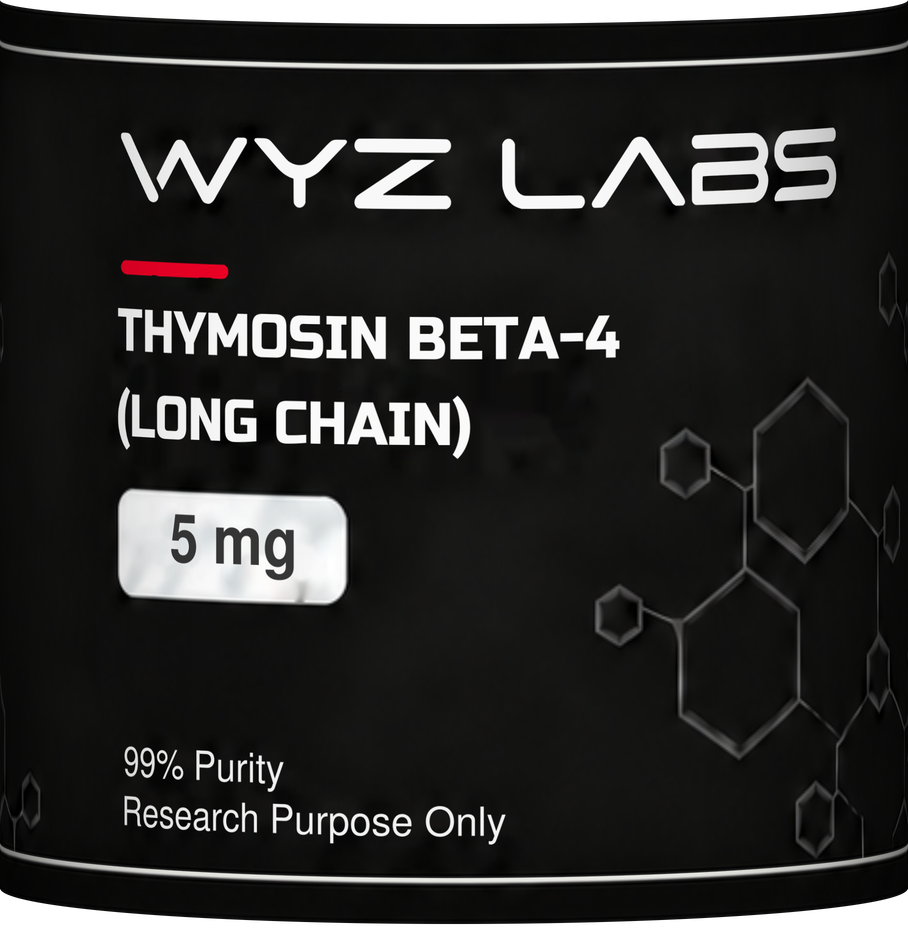
Full-length thymosin beta-4 is an endogenous 43-amino-acid peptide involved in cellular actin regulation. It is chemically distinct from the acetylated seven-residue fragment associated with short-chain TB-500. Studies of the complete peptide or a named clinical formulation should therefore be identified separately from fragment studies and from independently supplied research materials.
Reference identity
Research class
Actin-binding thymosin peptide
Catalog search names
TB-500 · TB500 · TB4 · Thymosin beta 4 long chain
Residue count
43 amino acids
Scope
Full-length thymosin beta-4Named full-length literature identity; final supplied identity still requires documentation
This reference describes the published literature. Exact supplied form and chemical specifications require product-specific documentation. The studies are linked in Selected literature.
Mechanisms under investigation
Thymosin beta-4 binds actin monomers and influences their availability for filament assembly. Biophysical work shows that this binding also changes actin structure and dynamics. In experimental cardiac systems, investigators additionally linked the peptide to an integrin-linked kinase-associated complex and Akt signaling, connecting cellular migration and survival observations with a specific pathway hypothesis.
Documented lines of inquiry
Research areas
01
Actin binding and structural dynamics
Purified-protein experiments characterized thymosin beta-4 interactions with actin under different nucleotide and cation conditions. These measurements help explain cytoskeletal regulation at a molecular level; they do not directly measure tissue healing. [1]
02
Experimental cardiac injury
Cell experiments and a mouse coronary-ligation model linked full-length thymosin beta-4 with cardiac-cell migration, survival, and improved functional measurements after injury. These preclinical results motivate investigation but do not establish a treatment effect in human cardiac disease. [2]
03
Ocular-surface clinical research
A randomized trial involving 72 participants tested an ophthalmic formulation for dry eye. Neither prespecified primary endpoint differed significantly from placebo, although some secondary measures favored the treatment. The primary and secondary findings should be presented together. [3]
Study topics describe the cited models, not established benefits of this catalog material.
Reading the evidence
What the studies can tell us.
Established actin biology; indication-specific clinical uncertainty
Molecular and animal studies support research interest in tissue responses. Human formulation research adds clinically relevant observations, but a trial with unsuccessful primary endpoints cannot be described simply as proving efficacy. Nor can ocular findings establish systemic repair benefits.
What remains uncertain
The complete peptide, short fragments, and clinical preparations have different evidentiary boundaries. Study route, formulation, injury model, and endpoint selection affect interpretation. The cited publications do not validate WYZ material or establish broad recovery claims, and favorable secondary outcomes require appropriately designed confirmation.
— Read the source
Selected literature
Primary studies and clearly identified supporting sources. Each link opens the original record.
Literature reviewed October 2026. This is a selected research overview, not an exhaustive systematic review. Published findings do not establish the identity, purity, sterility or suitability of any WYZ batch. For laboratory research only; not for human or veterinary use.
— Before you begin
The details behind the material.
Specifications and storage
Final product specifications and product-specific storage instructions have not been supplied. Review the original documentation and your laboratory’s procedures before obtaining or using the material.
Research use only
For qualified laboratory researchers. Not for human or veterinary use. Product information is not medical advice or a recommendation for personal use.
Retatrutide is a synthetic peptide studied for coordinated activation of three metabolic hormone receptors, with human research examining glucose regulation, appetite, body weight and liver fat.
MOTS-c is a mitochondrial-derived peptide studied in metabolic signaling and skeletal-muscle adaptation, with experimental interventions supported mainly by cell and animal evidence.
GHK-Cu is a copper complex of glycyl-histidyl-lysine studied for its effects on extracellular-matrix production and remodeling in experimental tissue-repair systems.