Made In USA✦For Laboratory Research Only✦COAs Not Yet Available✦Explore Compound Research Profiles✦Compare Catalog Sizes✦Research Requests Reviewed Individually✦Not For Human Or Veterinary Use✦
Made In USA✦For Laboratory Research Only✦COAs Not Yet Available✦Explore Compound Research Profiles✦Compare Catalog Sizes✦Research Requests Reviewed Individually✦Not For Human Or Veterinary Use✦
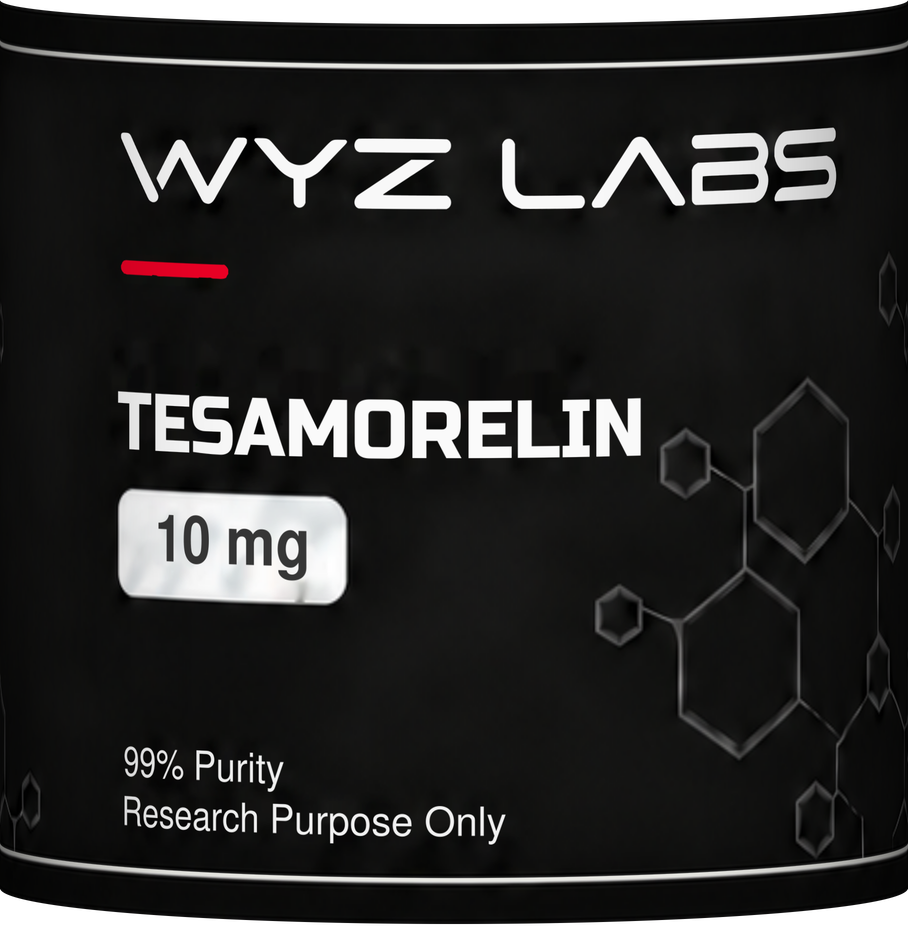
Tesamorelin is a stabilized GHRH analogue studied for changes in visceral and liver fat, principally in people with HIV-associated abdominal adiposity.
Tesamorelin is a synthetic analogue of the 44-residue human growth hormone-releasing hormone, with an N-terminal modification that improves stability. It belongs to the GHRH family rather than the ghrelin-mimetic GHRP family. Published clinical studies describe specified pharmaceutical formulations; their results do not establish the composition or performance of a WYZ Labs material.
Reference identity
Research class
GHRH analogue
Catalog search names
Tesa
Parent peptide
44-residue human growth hormone-releasing hormoneParent-peptide description; no complete supplied sequence asserted
Modification described
N-terminal modification
This reference describes the published literature. Exact supplied form and chemical specifications require product-specific documentation. The studies are linked in Selected literature.
Mechanisms under investigation
The molecule stimulates the pituitary GHRH receptor, promoting endogenous growth hormone release and downstream IGF-1 responses. This pathway links its endocrine activity to research on fat distribution. Hormonal changes, however, are intermediate measurements: they do not by themselves demonstrate improvements in cardiovascular outcomes or physical performance.
Documented lines of inquiry
Research areas
01
Visceral adipose tissue
Randomized studies in people with HIV and excess abdominal fat found reductions in visceral adipose tissue. The relevant endpoint is a particular internal fat compartment, rather than a demonstration of general weight loss across unrelated populations. [1]
02
Liver fat
A smaller placebo-controlled study measured liver fat alongside visceral fat and reported reductions in both. Its imaging findings supported further investigation but did not establish prevention of cirrhosis or other long-term liver outcomes. [2]
03
Glucose regulation
A separate short trial in people with type 2 diabetes evaluated insulin responses and glycemic control. Group differences were not significant over the study period, providing a limited metabolic observation rather than proof of universal glucose neutrality. [3]
Study topics describe the cited models, not established benefits of this catalog material.
Reading the evidence
What the studies can tell us.
Human randomized trials in defined populations
Tesamorelin has direct human trial evidence, including controlled studies with imaging and endocrine endpoints. The HIV studies and the diabetes study answer different questions and should not be pooled into an unrestricted claim about body composition, longevity, or metabolic health.
What remains uncertain
Population, treatment formulation, follow-up duration, and endpoint selection constrain interpretation. Early glucose changes and broader GH-axis effects warrant attention when reading the studies. These references contain no batch-specific testing, purity verification, or clinical equivalence evidence for the catalog material.
— Read the source
Selected literature
Primary studies and clearly identified supporting sources. Each link opens the original record.
Literature reviewed October 2026. This is a selected research overview, not an exhaustive systematic review. Published findings do not establish the identity, purity, sterility or suitability of any WYZ batch. For laboratory research only; not for human or veterinary use.
— Before you begin
The details behind the material.
Specifications and storage
Final product specifications and product-specific storage instructions have not been supplied. Review the original documentation and your laboratory’s procedures before obtaining or using the material.
Research use only
For qualified laboratory researchers. Not for human or veterinary use. Product information is not medical advice or a recommendation for personal use.
Retatrutide is a synthetic peptide studied for coordinated activation of three metabolic hormone receptors, with human research examining glucose regulation, appetite, body weight and liver fat.
MOTS-c is a mitochondrial-derived peptide studied in metabolic signaling and skeletal-muscle adaptation, with experimental interventions supported mainly by cell and animal evidence.
GHK-Cu is a copper complex of glycyl-histidyl-lysine studied for its effects on extracellular-matrix production and remodeling in experimental tissue-repair systems.