Made In USA✦For Laboratory Research Only✦COAs Not Yet Available✦Explore Compound Research Profiles✦Compare Catalog Sizes✦Research Requests Reviewed Individually✦Not For Human Or Veterinary Use✦
Made In USA✦For Laboratory Research Only✦COAs Not Yet Available✦Explore Compound Research Profiles✦Compare Catalog Sizes✦Research Requests Reviewed Individually✦Not For Human Or Veterinary Use✦
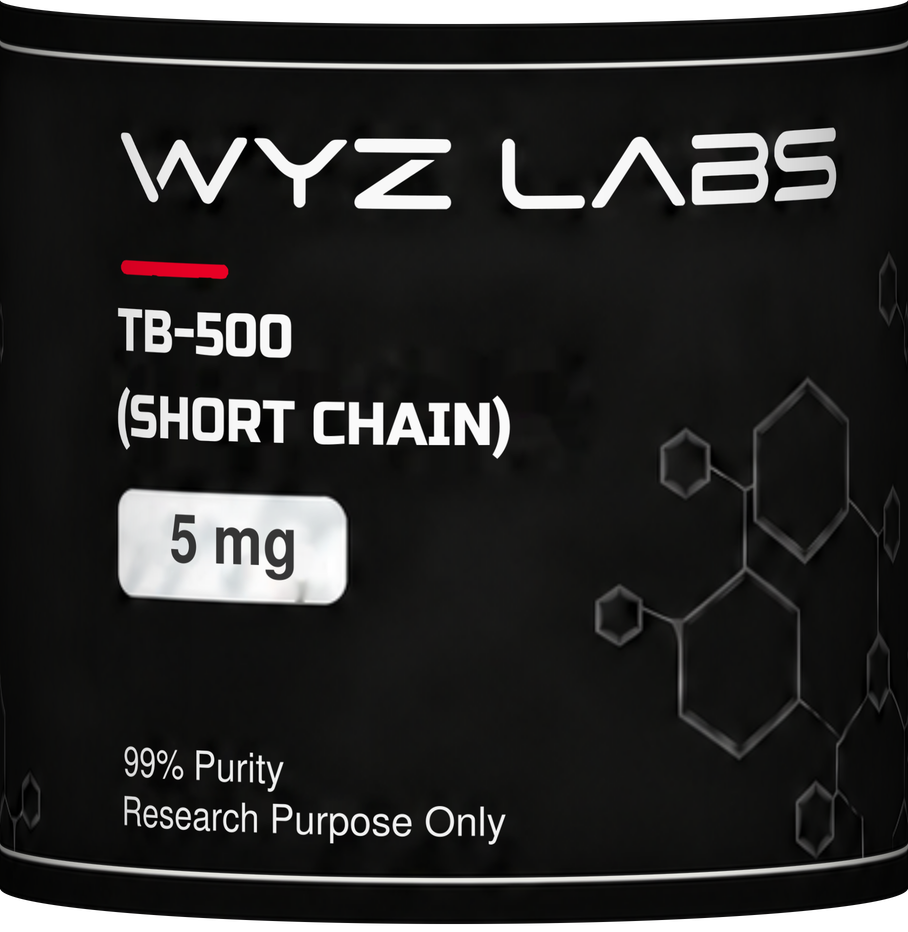
Short-chain TB-500 is associated with an acetylated seven-residue thymosin beta-4 fragment; analytical identification does not establish the therapeutic effects often inferred from the full-length parent peptide.
An analytical paper identified a product labeled TB-500 as Ac-LKKTETQ, the N-terminally acetylated fragment corresponding to residues 17–23 of thymosin beta-4. This seven-residue material differs substantially from the full 43-residue parent. Because TB-500 naming has not consistently mapped to one composition, the short-chain label should be interpreted alongside an explicit sequence and terminal-modification specification.
Reference identity
Research class
Thymosin beta-4-derived heptapeptide
Catalog search names
TB-500 fragment · TB500 short chain
Analytically identified example
Ac-LKKTETQSpecific product identified in a published analytical paper, not a confirmed WYZ sequence
Fragment origin
Thymosin beta-4 residues 17–23Published Ac-LKKTETQ example only; supplied sequence pending
Example length
Seven residuesPublished Ac-LKKTETQ example only; supplied sequence pending
Example terminal modification
N-terminal acetylationPublished Ac-LKKTETQ example only; supplied sequence pending
This reference describes the published literature. Exact supplied form and chemical specifications require product-specific documentation. The studies are linked in Selected literature.
Mechanisms under investigation
The parent protein participates in actin-monomer binding, but sequence overlap alone does not demonstrate that the isolated fragment retains its binding behavior or downstream effects. The cited fragment-identification study established chemical identity and analytical detectability; it did not demonstrate a therapeutic mechanism, injury recovery, or a clinical effect.
Documented lines of inquiry
Research areas
01
Fragment identification and reference synthesis
Researchers combined chromatography and high-resolution mass spectrometry to identify an acetylated thymosin fragment in a TB-500 product, then synthesized a matching reference. This supports a specific historical chemical assignment rather than every product using that name. [1]
02
Comparison with full-length thymosin
Biophysical experiments on full-length thymosin beta-4 showed changes in actin conformation and dynamics during binding. Such parent-protein data define useful comparative questions, but cannot establish that the short fragment reproduces the complete binding interaction. [3]
03
Variation behind product labels
A later analytical investigation found that examined internet products did not consistently match previously described compositions. This illustrates the importance of molecular identification. The paper does not establish the composition of any WYZ material. [2]
Study topics describe the cited models, not established benefits of this catalog material.
Reading the evidence
What the studies can tell us.
Analytical fragment evidence; parent biology is indirect
The directly relevant publications characterize compounds and naming inconsistencies, rather than testing the fragment in a controlled human efficacy trial. Full-length thymosin research belongs to a separate evidence stream and should retain that distinction.
What remains uncertain
No tissue-repair benefit, pharmacokinetic profile, or safety conclusion for the short fragment follows from these citations. Establishing a biological role would require experiments on the defined fragment with appropriate parent-peptide and inactive controls, followed by evidence relevant to the intended research endpoint.
— Read the source
Selected literature
Primary studies and clearly identified supporting sources. Each link opens the original record.
Literature reviewed October 2026. This is a selected research overview, not an exhaustive systematic review. Published findings do not establish the identity, purity, sterility or suitability of any WYZ batch. For laboratory research only; not for human or veterinary use.
— Before you begin
The details behind the material.
Specifications and storage
Final product specifications and product-specific storage instructions have not been supplied. Review the original documentation and your laboratory’s procedures before obtaining or using the material.
Research use only
For qualified laboratory researchers. Not for human or veterinary use. Product information is not medical advice or a recommendation for personal use.
Retatrutide is a synthetic peptide studied for coordinated activation of three metabolic hormone receptors, with human research examining glucose regulation, appetite, body weight and liver fat.
MOTS-c is a mitochondrial-derived peptide studied in metabolic signaling and skeletal-muscle adaptation, with experimental interventions supported mainly by cell and animal evidence.
GHK-Cu is a copper complex of glycyl-histidyl-lysine studied for its effects on extracellular-matrix production and remodeling in experimental tissue-repair systems.