Made In USA✦For Laboratory Research Only✦COAs Not Yet Available✦Explore Compound Research Profiles✦Compare Catalog Sizes✦Research Requests Reviewed Individually✦Not For Human Or Veterinary Use✦
Made In USA✦For Laboratory Research Only✦COAs Not Yet Available✦Explore Compound Research Profiles✦Compare Catalog Sizes✦Research Requests Reviewed Individually✦Not For Human Or Veterinary Use✦
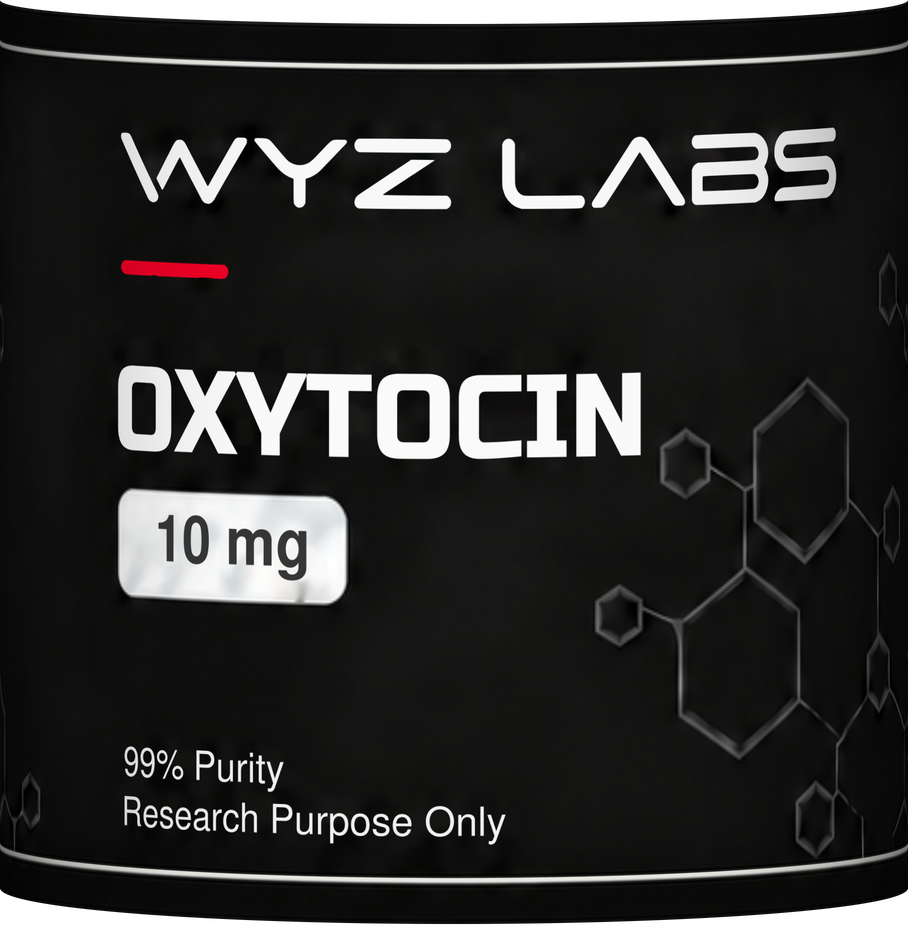
Oxytocin is a nine-residue hormone studied in peripheral reproductive physiology and context-dependent social signaling; behavioral findings do not imply a universal trust or bonding effect.
Oxytocin is a naturally occurring cyclic nonapeptide. Its endogenous roles and the actions of defined experimental preparations are related but not identical research questions. The existence of clinical oxytocin formulations does not establish the identity, formulation quality, or clinical equivalence of a separately supplied research material.
Reference identity
Research class
Endogenous neuropeptide hormone
Structure and length
Cyclic nonapeptide
This reference describes the published literature. Exact supplied form and chemical specifications require product-specific documentation. The studies are linked in Selected literature.
Mechanisms under investigation
Oxytocin acts through the oxytocin receptor, a G-protein-coupled receptor expressed in tissues including the uterus and mammary system. Receptor abundance and tissue context influence responses. Neural studies additionally examine how oxytocin changes responses to social information, where participant characteristics and experimental design can materially affect the result.
Documented lines of inquiry
Research areas
01
Receptor biology
The original human-receptor cloning study established receptor structure and functional responsiveness and examined expression in reproductive tissues. High uterine expression near labor illustrates why the same signaling molecule can produce different responses as tissue state changes. [1]
02
Context-dependent trust
A preregistered experiment in men selected for low dispositional trust found a change in trusting behavior during an anonymous economic task. Its deliberately narrow population and task make it informative about context, rather than evidence that oxytocin generally improves relationships. [2]
03
Clinical social-function endpoints
A larger placebo-controlled trial in children and adolescents with autism assessed social and cognitive outcomes over months. It did not find a significant advantage over placebo, limiting claims derived from smaller behavioral experiments or early clinical signals. [3]
Study topics describe the cited models, not established benefits of this catalog material.
Reading the evidence
What the studies can tell us.
Mechanistic studies and mixed human trial results
Oxytocin has extensive biological research, but findings depend strongly on the question being asked. A receptor experiment, an economic trust task, and a clinical social-function scale are not interchangeable endpoints. The positive task-specific finding and negative clinical trial should both remain visible.
What remains uncertain
Peripheral measurements do not automatically establish brain exposure or a specific behavioral mechanism. Results from selected male volunteers cannot simply be extended to children, clinical populations, or everyday relationships. None of these studies verifies a WYZ Labs batch or supports general wellness or human-use claims.
— Read the source
Selected literature
Primary studies and clearly identified supporting sources. Each link opens the original record.
Literature reviewed October 2026. This is a selected research overview, not an exhaustive systematic review. Published findings do not establish the identity, purity, sterility or suitability of any WYZ batch. For laboratory research only; not for human or veterinary use.
— Before you begin
The details behind the material.
Specifications and storage
Final product specifications and product-specific storage instructions have not been supplied. Review the original documentation and your laboratory’s procedures before obtaining or using the material.
Research use only
For qualified laboratory researchers. Not for human or veterinary use. Product information is not medical advice or a recommendation for personal use.
Retatrutide is a synthetic peptide studied for coordinated activation of three metabolic hormone receptors, with human research examining glucose regulation, appetite, body weight and liver fat.
MOTS-c is a mitochondrial-derived peptide studied in metabolic signaling and skeletal-muscle adaptation, with experimental interventions supported mainly by cell and animal evidence.
GHK-Cu is a copper complex of glycyl-histidyl-lysine studied for its effects on extracellular-matrix production and remodeling in experimental tissue-repair systems.