Made In USA✦For Laboratory Research Only✦COAs Not Yet Available✦Explore Compound Research Profiles✦Compare Catalog Sizes✦Research Requests Reviewed Individually✦Not For Human Or Veterinary Use✦
Made In USA✦For Laboratory Research Only✦COAs Not Yet Available✦Explore Compound Research Profiles✦Compare Catalog Sizes✦Research Requests Reviewed Individually✦Not For Human Or Veterinary Use✦
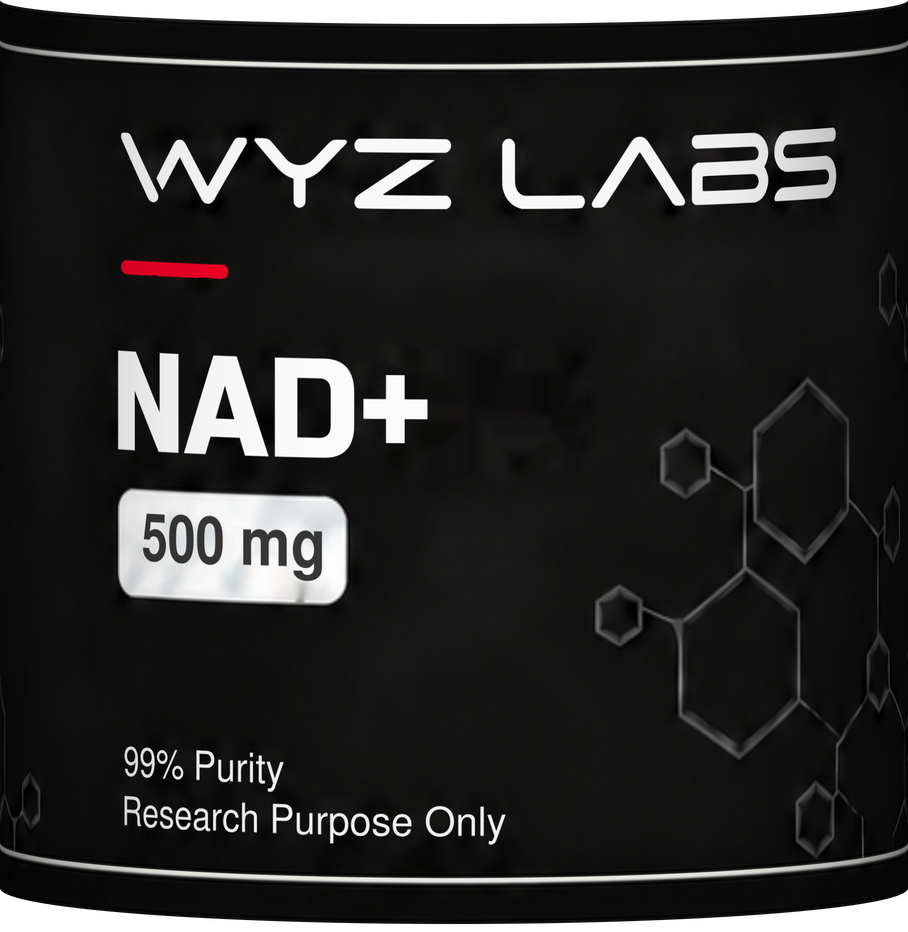
NAD+ is an endogenous coenzyme central to cellular energy and signaling, with research spanning mitochondrial transport, aging biology and the metabolism of administered NAD+.
Nicotinamide adenine dinucleotide in its oxidized form, NAD+, is a nucleotide coenzyme rather than a peptide. Its reduced counterpart is NADH. NAD+ itself must also be distinguished from nicotinamide, nicotinamide riboside and nicotinamide mononucleotide, which participate in related but nonidentical metabolic pathways.
Reference identity
Research class
Redox coenzyme
Catalog search names
NAD
Chemical class
Nucleotide coenzyme
Named form
Oxidized nicotinamide adenine dinucleotide
This reference describes the published literature. Exact supplied form and chemical specifications require product-specific documentation. The studies are linked in Selected literature.
Mechanisms under investigation
By cycling between NAD+ and NADH, the coenzyme transfers electrons during nutrient metabolism and mitochondrial energy production. It is also consumed by enzymes involved in ADP-ribosylation and deacetylation. Extracellular NAD+ may undergo breakdown before its components contribute to intracellular pools, so adding it outside cells does not necessarily increase every tissue compartment directly.
Documented lines of inquiry
Research areas
01
Human metabolite handling
A small pilot study followed plasma and urinary metabolites during controlled NAD+ infusion. It documented time-dependent metabolism and excretion, including an initial period without a plasma NAD+ increase. The study was designed to examine metabolic handling, not disease treatment. [1]
02
Extracellular breakdown
Experiments in human HEK293 cells showed that both cells and culture medium can transform extracellular NAD-related compounds. Under the tested conditions, cleavage contributed to use of extracellular nucleotides for maintaining intracellular NAD, highlighting the importance of culture conditions. [2]
03
Cellular energy and aging
Cell experiments identified SLC25A51 as a mitochondrial NAD+ transporter; disrupting it reduced mitochondrial NAD+ and respiration without lowering whole-cell NAD+. Separately, measurements from 49 human skin samples linked older age with lower NAD+ levels. These findings motivate energy and aging research but do not show that administered NAD+ increases vitality or slows aging. [3][4]
Study topics describe the cited models, not established benefits of this catalog material.
Reading the evidence
What the studies can tell us.
Human metabolism and tissue studies with cell evidence
The direct-NAD+ human pilot included eight exposed participants and three controls and measured metabolite handling. The skin study examined an age association in one tissue, while cell experiments investigated processing and mitochondrial transport. Together they describe different parts of NAD+ biology; a change in one measured compartment does not establish improvement in whole-body function.
What remains uncertain
These studies do not establish anti-aging, cognitive, addiction-treatment or performance benefits. Results from NR or NMN studies cannot be relabeled as evidence for administered NAD+. Route and formulation matter, and published research does not verify the stability, identity or equivalence of the WYZ catalog material.
— Read the source
Selected literature
Primary studies and clearly identified supporting sources. Each link opens the original record.
Literature reviewed October 2026. This is a selected research overview, not an exhaustive systematic review. Published findings do not establish the identity, purity, sterility or suitability of any WYZ batch. For laboratory research only; not for human or veterinary use.
— Before you begin
The details behind the material.
Specifications and storage
Final product specifications and product-specific storage instructions have not been supplied. Review the original documentation and your laboratory’s procedures before obtaining or using the material.
Research use only
For qualified laboratory researchers. Not for human or veterinary use. Product information is not medical advice or a recommendation for personal use.
Retatrutide is a synthetic peptide studied for coordinated activation of three metabolic hormone receptors, with human research examining glucose regulation, appetite, body weight and liver fat.
MOTS-c is a mitochondrial-derived peptide studied in metabolic signaling and skeletal-muscle adaptation, with experimental interventions supported mainly by cell and animal evidence.
GHK-Cu is a copper complex of glycyl-histidyl-lysine studied for its effects on extracellular-matrix production and remodeling in experimental tissue-repair systems.