Made In USA✦For Laboratory Research Only✦COAs Not Yet Available✦Explore Compound Research Profiles✦Compare Catalog Sizes✦Research Requests Reviewed Individually✦Not For Human Or Veterinary Use✦
Made In USA✦For Laboratory Research Only✦COAs Not Yet Available✦Explore Compound Research Profiles✦Compare Catalog Sizes✦Research Requests Reviewed Individually✦Not For Human Or Veterinary Use✦
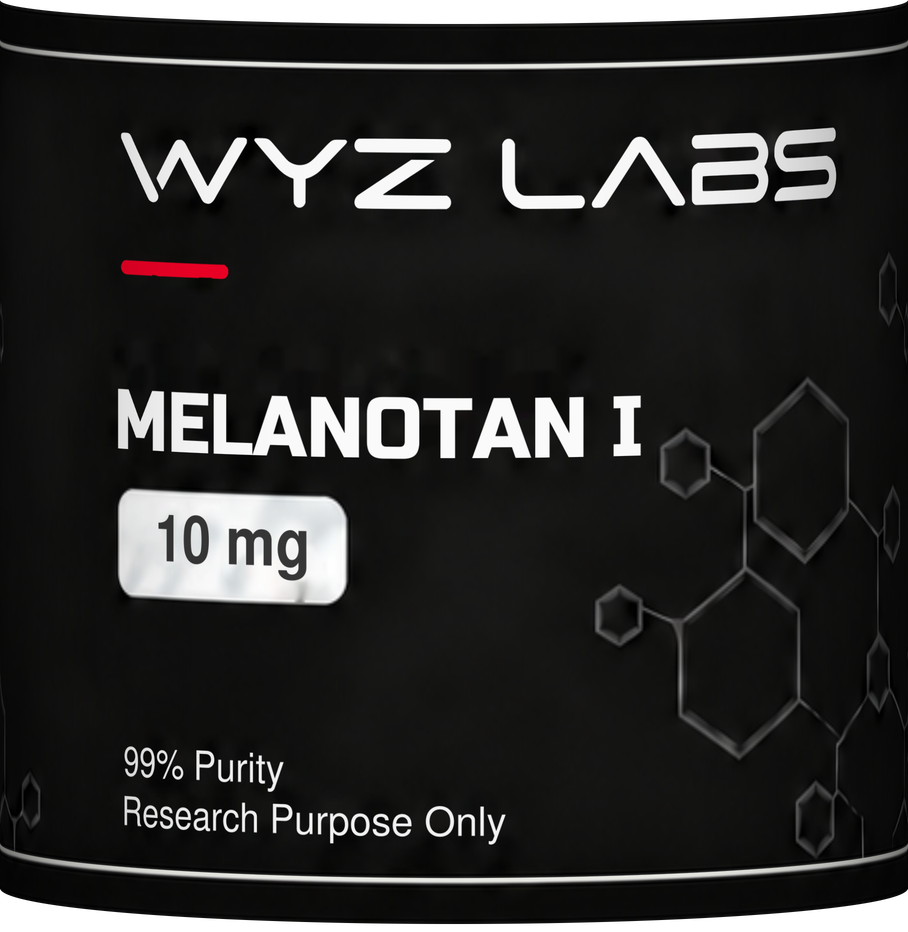
Melanotan I is an alpha-MSH analogue studied in pigmentation biology; clinical afamelanotide implant research must be distinguished from a catalog research material.
Melanotan I refers to the linear alpha-melanocyte-stimulating hormone analogue commonly designated [Nle4,D-Phe7]-alpha-MSH. The name afamelanotide is used in the clinical literature for this active peptide. A shared molecular designation does not make a research vial equivalent to the controlled-release implant formulation evaluated in clinical trials.
Reference identity
Research class
Alpha-MSH analogue
Catalog search names
Melanotan 1 · MT-1
Structural description
Linear alpha-MSH analogue
Literature designation
[Nle4,D-Phe7]-alpha-MSH
Clinical literature name
Afamelanotide
This reference describes the published literature. Exact supplied form and chemical specifications require product-specific documentation. The studies are linked in Selected literature.
Mechanisms under investigation
The peptide engages melanocortin signaling, including the MC1 receptor on pigment-producing melanocytes. The resulting melanogenic response is studied through skin reflectance, pigment chemistry, and clinical light-tolerance measures. These endpoints describe different properties: visible pigmentation alone cannot establish protection against all consequences of light exposure.
Documented lines of inquiry
Research areas
01
Pigmentation and pharmacokinetics
An early human study paired circulating-peptide measurements with serial skin reflectance. It demonstrated measurable pigmentation changes in a very small volunteer sample. Its exposure findings belong to the tested formulation and experimental routes, rather than to every product sharing the name. [1]
02
Pigment composition
A subsequent human investigation assessed eumelanin chemically as well as measuring skin color. The design helps distinguish a visual tanning observation from a biochemical pigment measurement, although sample size and site-specific responses restrict broad conclusions. [2]
03
Phototoxicity in a defined disease
Randomized afamelanotide implant trials in erythropoietic protoporphyria evaluated time in sunlight without pain and quality of life. Those disease-specific outcomes are clinically meaningful within their study population; they do not establish a general cosmetic or skin-cancer-prevention benefit. [3]
Study topics describe the cited models, not established benefits of this catalog material.
Reading the evidence
What the studies can tell us.
Human studies; formulation-specific clinical evidence
The literature spans small early pigmentation experiments and larger controlled studies of an afamelanotide implant. The latter provide stronger clinical evidence for a defined condition and preparation. They do not verify the specifications or biological equivalence of the WYZ Labs catalog item.
What remains uncertain
Confirm peptide identity and distinguish active molecule from finished formulation. Changes in pigmentation, light tolerance, and cancer risk are not interchangeable outcomes. The references supply no WYZ-specific manufacturing, purity, or COA evidence and should not be converted into human-use instructions.
— Read the source
Selected literature
Primary studies and clearly identified supporting sources. Each link opens the original record.
Literature reviewed October 2026. This is a selected research overview, not an exhaustive systematic review. Published findings do not establish the identity, purity, sterility or suitability of any WYZ batch. For laboratory research only; not for human or veterinary use.
— Before you begin
The details behind the material.
Specifications and storage
Final product specifications and product-specific storage instructions have not been supplied. Review the original documentation and your laboratory’s procedures before obtaining or using the material.
Research use only
For qualified laboratory researchers. Not for human or veterinary use. Product information is not medical advice or a recommendation for personal use.
Retatrutide is a synthetic peptide studied for coordinated activation of three metabolic hormone receptors, with human research examining glucose regulation, appetite, body weight and liver fat.
MOTS-c is a mitochondrial-derived peptide studied in metabolic signaling and skeletal-muscle adaptation, with experimental interventions supported mainly by cell and animal evidence.
GHK-Cu is a copper complex of glycyl-histidyl-lysine studied for its effects on extracellular-matrix production and remodeling in experimental tissue-repair systems.