


Made In USAFor Laboratory Research OnlyCOAs Not Yet AvailableExplore Compound Research ProfilesCompare Catalog SizesResearch Requests Reviewed IndividuallyNot For Human Or Veterinary Use
Single compound

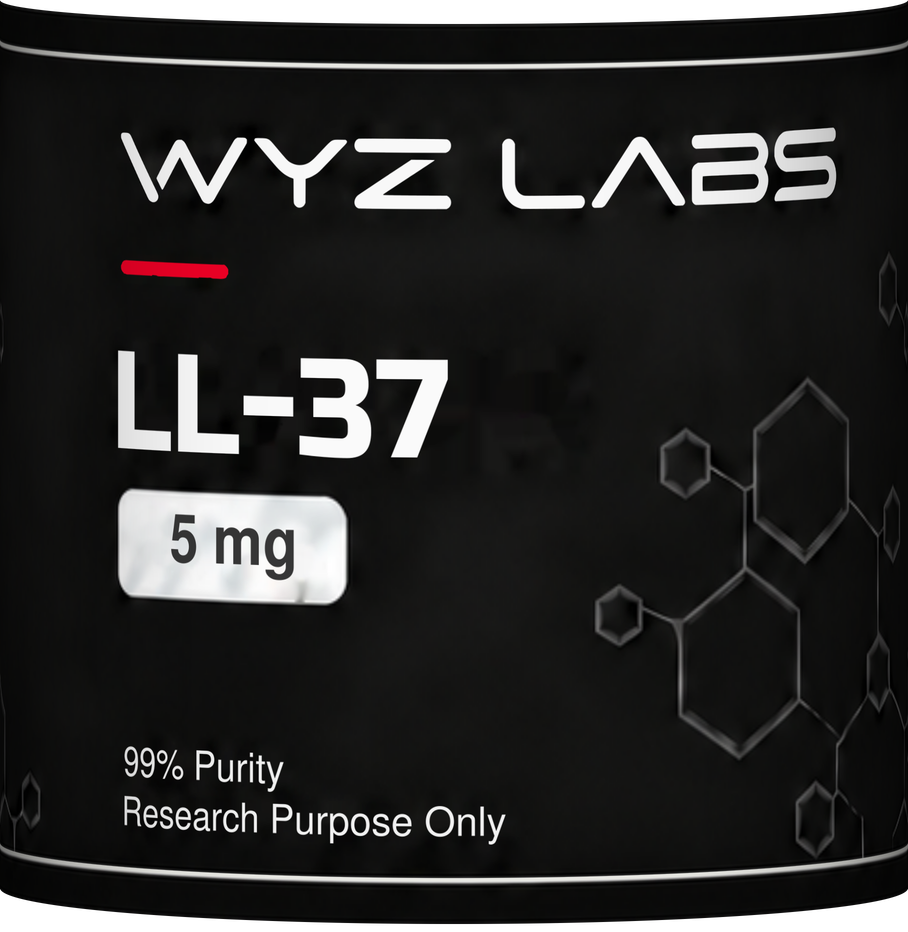
LL-37

Catalog size
$54
USD per vial · 5 mgCatalog price
Research only

LL-37 is a human host-defense peptide with immune-signaling research and a venous-ulcer trial that found no significant benefit across its full study population.

Explore the research profile

Submit an unpaid laboratory order request for manual review. Availability and any pending amounts require confirmation.

No reservation or purchase is made by adding a material.
View documentation status ← Back to collection
Material
LL-37
Format
Awaiting confirmation
Availability
Confirmed during review

Catalog quantities are not assay results.

In the literature

A closer look at the science.

Human cathelicidin host-defense peptide

What is LL-37?

LL-37 is a 37-residue peptide produced by cleavage of the human cathelicidin precursor hCAP18. Neutrophils and epithelial cells contribute to its biological context. Its endogenous role in host defense is distinct from the question of whether an externally supplied formulation improves a particular disease outcome.

Reference identity
Research class
Human cathelicidin host-defense peptide
Catalog search names
LL37
Residue count
37 residues
Precursor
Human cathelicidin hCAP18

This reference describes the published literature. Exact supplied form and chemical specifications require product-specific documentation. The studies are linked in Selected literature.

Mechanisms under investigation

Cell experiments show that LL-37 can recruit immune cells and stimulate calcium signaling through the receptor historically called FPRL1. This complements its antimicrobial research background. A response involving immune-cell recruitment should not be simplified into a universal anti-inflammatory or immune-enhancing effect.

Documented lines of inquiry

Research areas

  1. 01

    Immune-cell communication

    Experiments with human monocytes, neutrophils, T cells, and receptor-expressing cells examined chemotaxis and calcium responses. These results support a signaling role in host defense, while remaining laboratory observations rather than demonstrations of benefit in patients. [1]

  2. 02

    Venous-ulcer healing

    A randomized, blinded phase IIb study evaluated a topical LL-37 formulation alongside compression therapy in 148 participants. The efficacy analysis found no significant healing improvement versus placebo across the full study population. [2]

  3. 03

    Exploratory clinical subgroups

    A post hoc analysis of the same trial reported favorable findings among participants with larger ulcers. Because that analysis followed the overall evaluation, it generates a hypothesis requiring a suitably designed confirmatory trial rather than establishing an effective subgroup treatment. [2]

Study topics describe the cited models, not established benefits of this catalog material.

Reading the evidence

What the studies
can tell us.

Cell evidence and a human trial with a negative overall result

The clinical literature cited here concerns a particular topical formulation and wound population. It does not establish systemic benefits, general infection treatment, or improved immune function. Biological activity of the naturally occurring peptide and efficacy of a manufactured intervention are separate research questions.

What remains uncertain

The exploratory subgroup signal should remain secondary to the trial's overall negative result. Findings cannot be transferred across administration routes, disease settings, or formulations. Neither the immune-cell experiments nor the clinical study establishes equivalence to WYZ Labs materials or resolves long-term safety in other contexts.

Read the source

Selected literature

Primary studies and clearly identified supporting sources. Each link opens the original record.

  1. 01
    2000 · Cell study

    LL-37, the neutrophil granule- and epithelial cell-derived cathelicidin, utilizes formyl peptide receptor-like 1 (FPRL1) as a receptor… (opens a new tab)

    Title abbreviated. Human leukocyte and receptor-transfected-cell chemotaxis experiments.

    PubMed
  2. 02
    2021 · Human trial

    Evaluation of LL-37 in healing of hard-to-heal venous leg ulcers: A multicentric prospective randomized placebo-controlled clinical trial (opens a new tab)

    148 participants; no significant overall healing benefit, with exploratory post hoc subgroup findings.

    PubMed

Literature reviewed October 2026. This is a selected research overview, not an exhaustive systematic review. Published findings do not establish the identity, purity, sterility or suitability of any WYZ batch. For laboratory research only; not for human or veterinary use.

Before you begin

The details behind
the material.

Specifications and storage

Final product specifications and product-specific storage instructions have not been supplied. Review the original documentation and your laboratory’s procedures before obtaining or using the material.

Research use only

For qualified laboratory researchers. Not for human or veterinary use. Product information is not medical advice or a recommendation for personal use.

What to look for in a COA
Before you explore

Laboratory
research only.

Please confirm the following to enter the Wyz Labs collection.

Select both confirmations to continue.

Your acknowledgment is remembered for this browser session. This is a self-declaration, not identity verification.

