Made In USA✦For Laboratory Research Only✦COAs Not Yet Available✦Explore Compound Research Profiles✦Compare Catalog Sizes✦Research Requests Reviewed Individually✦Not For Human Or Veterinary Use✦
Made In USA✦For Laboratory Research Only✦COAs Not Yet Available✦Explore Compound Research Profiles✦Compare Catalog Sizes✦Research Requests Reviewed Individually✦Not For Human Or Veterinary Use✦
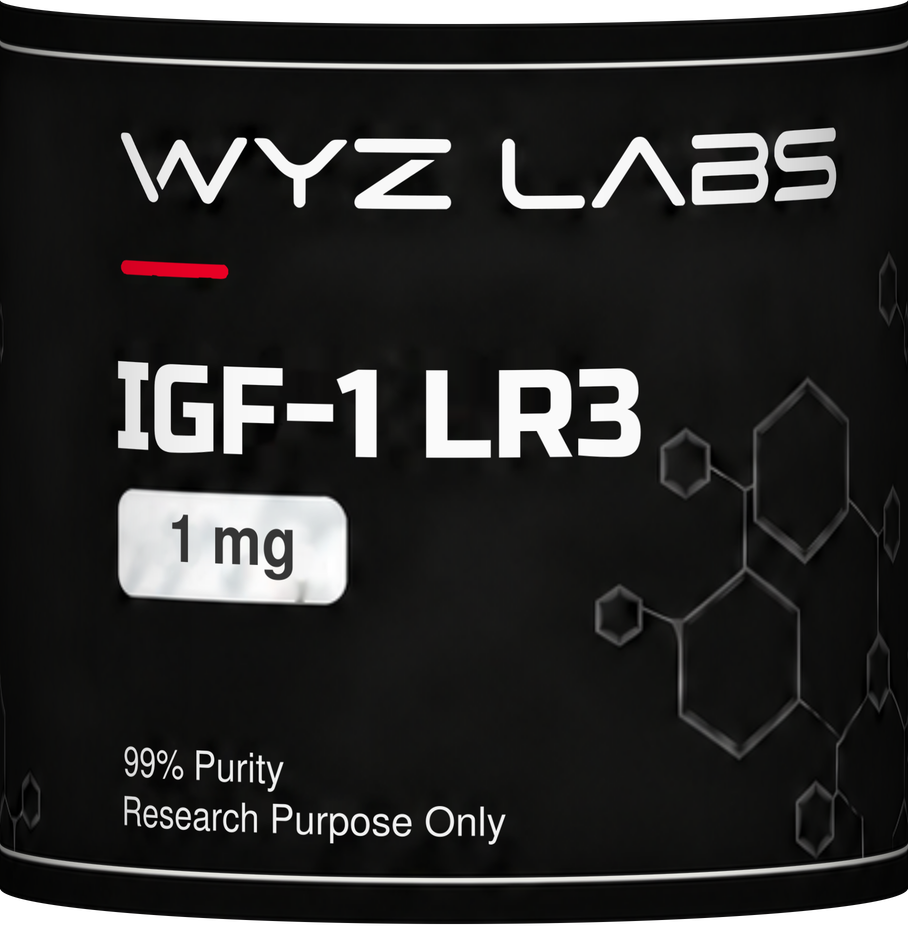
Long R3 IGF-1 combines an arginine substitution at position three of the IGF-1 sequence with a 13-residue N-terminal extension. It is therefore different from native IGF-1 and from clinical preparations of recombinant human IGF-1. Evidence concerning ordinary IGF-1 cannot be relabeled as direct evidence for LR3.
Reference identity
Research class
Modified IGF-1 analogue
Catalog search names
IGF1 LR3 · IGF-1 LR-3
Substitution
Arginine at IGF-1 sequence position three
Extension
13-residue N-terminal extension
This reference describes the published literature. Exact supplied form and chemical specifications require product-specific documentation. The studies are linked in Selected literature.
Mechanisms under investigation
The modifications reduce interactions with IGF-binding proteins while retaining receptor-mediated biological activity. This can increase the amount of analogue available to cells in particular experimental systems. Greater activity is context-dependent: the original comparison found a different potency relationship in cells that did not secrete detectable binding proteins.
Documented lines of inquiry
Research areas
01
Binding proteins and cell responses
The original recombinant-analogue study compared receptor binding, binding-protein interactions, and protein or DNA synthesis in several cell systems. It supports using LR3 to investigate how extracellular binding proteins shape growth-factor responses, rather than assuming universal potency advantages. [1]
02
Intestinal epithelial proliferation
A rat experiment compared LR3 with native IGF-1 and observed differences in intestinal tissue growth and crypt-cell responses. This is direct animal evidence for the analogue, but proliferating rodent intestinal tissue is not a surrogate for human muscle development. [2]
03
Growth versus functional change
Another rat study measured intestinal glucose-analogue absorption alongside tissue growth. Some absorption differences weakened when expressed relative to tissue weight. The work illustrates that an enlarged tissue compartment does not necessarily have proportionally improved cellular transport function. [3]
Study topics describe the cited models, not established benefits of this catalog material.
Reading the evidence
What the studies can tell us.
Cell and animal evidence
The selected evidence is preclinical and directly identifies Long R3 IGF-1. It establishes useful experimental distinctions from native IGF-1 but does not establish a human therapeutic benefit. Cell-line behavior, rodent tissue growth, and clinical outcomes are separate levels of evidence.
What remains uncertain
Confirm the extension, substitution, folding, and material identity when comparing a preparation with published LR3 experiments. Neither native IGF-1 clinical trials nor increased cell proliferation proves that this analogue is safe or effective in people. No WYZ Labs analytical or manufacturing claim follows from these papers.
— Read the source
Selected literature
Primary studies and clearly identified supporting sources. Each link opens the original record.
Literature reviewed October 2026. This is a selected research overview, not an exhaustive systematic review. Published findings do not establish the identity, purity, sterility or suitability of any WYZ batch. For laboratory research only; not for human or veterinary use.
— Before you begin
The details behind the material.
Specifications and storage
Final product specifications and product-specific storage instructions have not been supplied. Review the original documentation and your laboratory’s procedures before obtaining or using the material.
Research use only
For qualified laboratory researchers. Not for human or veterinary use. Product information is not medical advice or a recommendation for personal use.
Retatrutide is a synthetic peptide studied for coordinated activation of three metabolic hormone receptors, with human research examining glucose regulation, appetite, body weight and liver fat.
MOTS-c is a mitochondrial-derived peptide studied in metabolic signaling and skeletal-muscle adaptation, with experimental interventions supported mainly by cell and animal evidence.
GHK-Cu is a copper complex of glycyl-histidyl-lysine studied for its effects on extracellular-matrix production and remodeling in experimental tissue-repair systems.