Made In USA✦For Laboratory Research Only✦COAs Not Yet Available✦Explore Compound Research Profiles✦Compare Catalog Sizes✦Research Requests Reviewed Individually✦Not For Human Or Veterinary Use✦
Made In USA✦For Laboratory Research Only✦COAs Not Yet Available✦Explore Compound Research Profiles✦Compare Catalog Sizes✦Research Requests Reviewed Individually✦Not For Human Or Veterinary Use✦
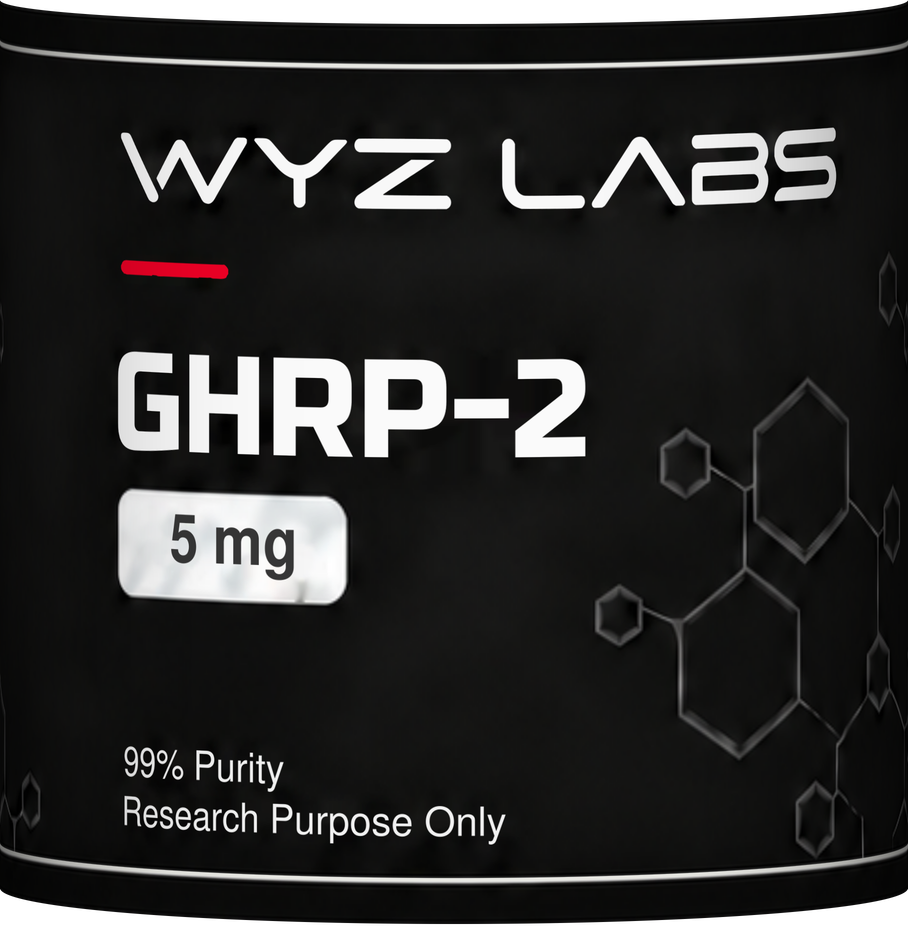
GHRP-2 is a synthetic growth hormone secretagogue investigated as a probe of GH release, appetite, and the interaction between ghrelin and GHRH signaling.
Growth hormone-releasing peptide-2 is a small synthetic peptide commonly called GHRP-2. Its research lineage is distinct from GHRH-derived molecules such as sermorelin. Papers describing GHRP-2 should also be separated from studies of GHRP-6, hexarelin, or other secretagogues, because shared receptor activity does not guarantee identical endocrine profiles.
Reference identity
Research class
Ghrelin-receptor agonist
Expanded name
Growth hormone-releasing peptide-2
Structural class
Synthetic peptide
This reference describes the published literature. Exact supplied form and chemical specifications require product-specific documentation. The studies are linked in Selected literature.
Mechanisms under investigation
GHRP-2 activates the growth hormone secretagogue receptor, the receptor used by ghrelin. This connects pituitary GH secretion with appetite-related signaling. The response also depends on the surrounding hypothalamic and pituitary system; experiments involving GHRH combinations probe that interaction rather than replacing it with a single isolated pathway.
Documented lines of inquiry
Research areas
01
Acute appetite signaling
A small crossover experiment in healthy lean men measured greater food intake and higher GH after GHRP-2 than after saline. The study established an acute physiological response, without testing sustained changes in body weight or nutritional status. [1]
02
Responses across body composition
A subsequent controlled study included lean and obese participants. Both groups showed food-intake and GH responses, illustrating that an appetite signal can remain experimentally responsive despite differences in adiposity. This was not a weight-management efficacy trial. [2]
03
Pituitary responsiveness
A pediatric physiology study compared GHRP-2, GHRH(1–29), and their combination in children with different growth disorders. Variable responses emphasize the role of underlying endocrine function and the distinction between a stimulation test and a lasting growth outcome. [3]
Study topics describe the cited models, not established benefits of this catalog material.
Reading the evidence
What the studies can tell us.
Small human physiology studies
Direct human evidence supports measurable acute effects on appetite and GH secretion under controlled conditions. The cited studies involve limited samples, selected participants, and specific study preparations. They do not establish durable changes in muscle, fat, recovery, or wellbeing in a general population.
What remains uncertain
An increase in a circulating hormone is not proof of a beneficial clinical outcome. Nutritional state, pituitary function, and other hormonal responses can alter interpretation. The references should not be used to infer WYZ Labs batch identity, selectivity, purity, or suitability for human use.
— Read the source
Selected literature
Primary studies and clearly identified supporting sources. Each link opens the original record.
Literature reviewed October 2026. This is a selected research overview, not an exhaustive systematic review. Published findings do not establish the identity, purity, sterility or suitability of any WYZ batch. For laboratory research only; not for human or veterinary use.
— Before you begin
The details behind the material.
Specifications and storage
Final product specifications and product-specific storage instructions have not been supplied. Review the original documentation and your laboratory’s procedures before obtaining or using the material.
Research use only
For qualified laboratory researchers. Not for human or veterinary use. Product information is not medical advice or a recommendation for personal use.
Retatrutide is a synthetic peptide studied for coordinated activation of three metabolic hormone receptors, with human research examining glucose regulation, appetite, body weight and liver fat.
MOTS-c is a mitochondrial-derived peptide studied in metabolic signaling and skeletal-muscle adaptation, with experimental interventions supported mainly by cell and animal evidence.
GHK-Cu is a copper complex of glycyl-histidyl-lysine studied for its effects on extracellular-matrix production and remodeling in experimental tissue-repair systems.