Made In USA✦For Laboratory Research Only✦COAs Not Yet Available✦Explore Compound Research Profiles✦Compare Catalog Sizes✦Research Requests Reviewed Individually✦Not For Human Or Veterinary Use✦
Made In USA✦For Laboratory Research Only✦COAs Not Yet Available✦Explore Compound Research Profiles✦Compare Catalog Sizes✦Research Requests Reviewed Individually✦Not For Human Or Veterinary Use✦
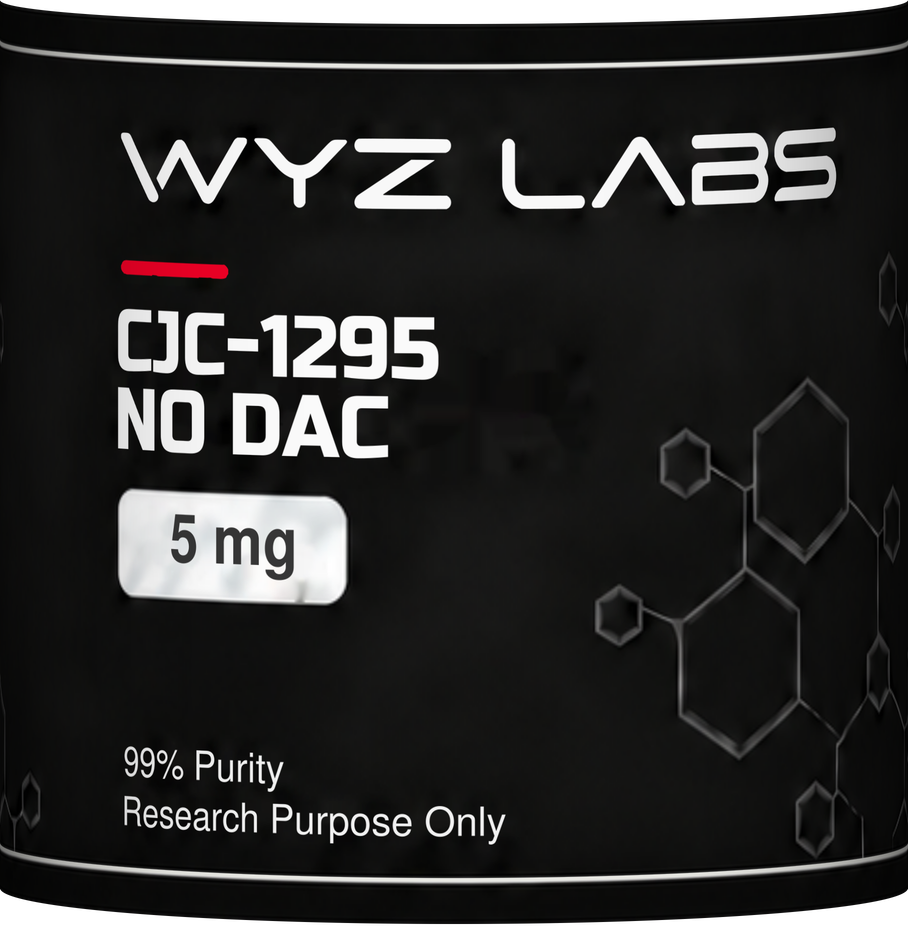
CJC-1295 no DAC is a catalog designation for a GHRH-related peptide that must be distinguished from the albumin-binding, long-acting CJC-1295 used in published human trials.
The catalog also uses the alias Mod GRF, but that name alone does not confirm a complete sequence or terminal chemistry. The original CJC-1295 research compound contained a modified GHRH(1–29) sequence plus an albumin-reactive attachment. Removing that attachment changes the molecule; the no-DAC designation therefore cannot identify it as the same trial substance.
Reference identity
Research class
GHRH analogue; identity qualification required
Catalog search names
CJC · CJC-1295 · Mod GRF
Catalog alias discussed in profile
Mod GRF
Construct qualification
Complete sequence and terminal chemistry not confirmedExplicit identity limitation
Related trial substance
Modified GHRH(1–29) plus an albumin-reactive attachmentRelated original CJC-1295 trial construct, explicitly not the no-DAC supplied identity
This reference describes the published literature. Exact supplied form and chemical specifications require product-specific documentation. The studies are linked in Selected literature.
Mechanisms under investigation
For a correctly identified modified GHRH peptide, the intended research target is the pituitary GHRH receptor and the resulting GH–IGF-1 axis. Albumin attachment chiefly changes exposure and persistence. Receptor-class similarity does not make the concentration-time profile or measured endocrine effects interchangeable between attached and unattached analogues.
Documented lines of inquiry
Research areas
01
Peptide stability and albumin binding
The original development study examined albumin conjugates in pituitary-cell assays and rats. It demonstrates why the reactive attachment matters, rather than supplying stability measurements for an unspecified no-DAC preparation. [1]
02
GH and IGF-1 responses
Controlled human trials found prolonged endocrine responses to long-acting CJC-1295. Those data concern the albumin-binding compound. Its multi-day exposure and hormone-response results should not be presented as measurements of the catalog's no-DAC material. [2]
03
Patterns of hormone secretion
A human follow-up study evaluated GH pulsatility during sustained CJC-1295 stimulation. Pulses persisted while basal secretion increased, illustrating why average hormone levels and pulse structure are separate endpoints. Again, the tested analogue contained the albumin-binding functionality. [3]
Study topics describe the cited models, not established benefits of this catalog material.
The cited papers are primary studies of long-acting CJC-1295, not direct validation of this catalog designation. They provide background on GHRH analogue design and endocrine measurements. None establishes efficacy or pharmacokinetics for the specific no-DAC material offered here.
What remains uncertain
Confirm the amino-acid sequence, substitutions, terminal groups, and absence of the albumin-reactive moiety before matching this entry to a paper. Claims about duration, clinical outcomes, or safety cannot be transferred from the DAC compound merely because both names include CJC-1295.
— Read the source
Selected literature
Primary studies and clearly identified supporting sources. Each link opens the original record.
Literature reviewed October 2026. This is a selected research overview, not an exhaustive systematic review. Published findings do not establish the identity, purity, sterility or suitability of any WYZ batch. For laboratory research only; not for human or veterinary use.
— Before you begin
The details behind the material.
Specifications and storage
Final product specifications and product-specific storage instructions have not been supplied. Review the original documentation and your laboratory’s procedures before obtaining or using the material.
Research use only
For qualified laboratory researchers. Not for human or veterinary use. Product information is not medical advice or a recommendation for personal use.
Retatrutide is a synthetic peptide studied for coordinated activation of three metabolic hormone receptors, with human research examining glucose regulation, appetite, body weight and liver fat.
MOTS-c is a mitochondrial-derived peptide studied in metabolic signaling and skeletal-muscle adaptation, with experimental interventions supported mainly by cell and animal evidence.
GHK-Cu is a copper complex of glycyl-histidyl-lysine studied for its effects on extracellular-matrix production and remodeling in experimental tissue-repair systems.