Made In USA✦For Laboratory Research Only✦COAs Not Yet Available✦Explore Compound Research Profiles✦Compare Catalog Sizes✦Research Requests Reviewed Individually✦Not For Human Or Veterinary Use✦
Made In USA✦For Laboratory Research Only✦COAs Not Yet Available✦Explore Compound Research Profiles✦Compare Catalog Sizes✦Research Requests Reviewed Individually✦Not For Human Or Veterinary Use✦
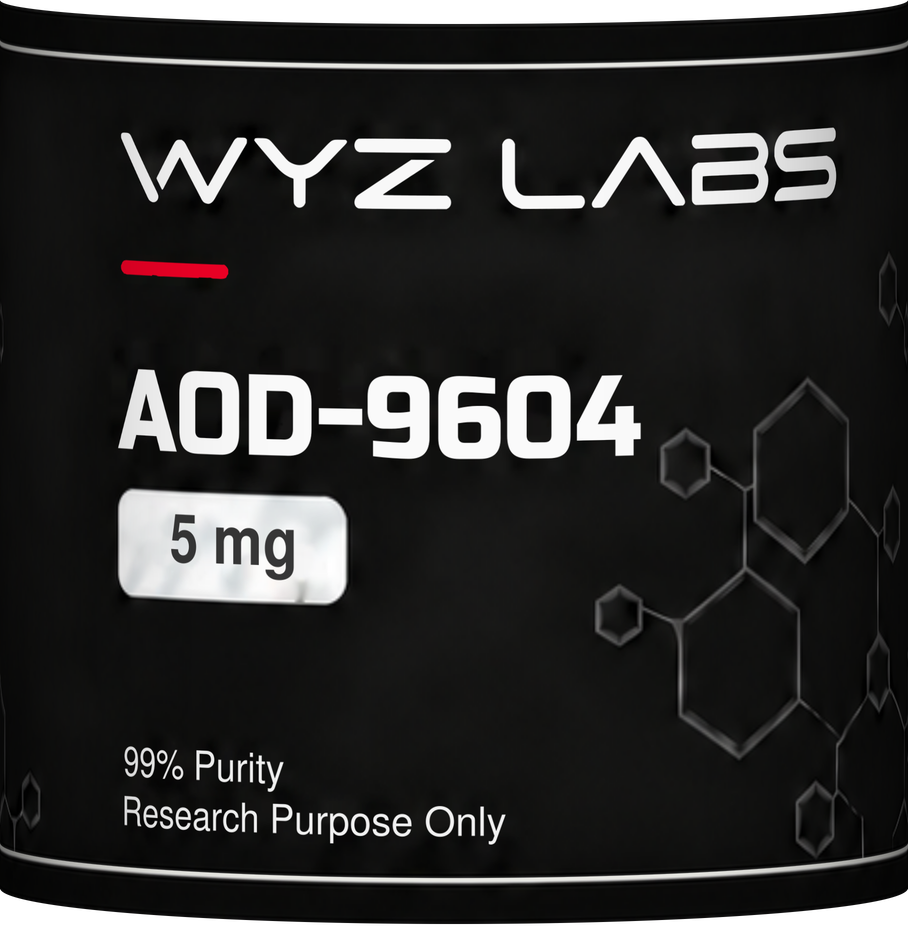
AOD-9604 is a modified growth-hormone fragment studied primarily in experimental lipid-metabolism models and analytical investigations of peptide breakdown.
AOD-9604 contains the C-terminal 177–191 region of human growth hormone with an additional N-terminal tyrosine. This modified fragment is distinct from intact growth hormone. Its name and origin do not establish that it reproduces the full hormone's receptor activity or physiological effects.
Reference identity
Research class
Growth-hormone-derived peptide fragment
Catalog search names
AOD 9604
Parent region
Human growth hormone, C-terminal 177–191
Modification
Additional N-terminal tyrosine
This reference describes the published literature. Exact supplied form and chemical specifications require product-specific documentation. The studies are linked in Selected literature.
Mechanisms under investigation
Animal studies investigated whether a limited growth-hormone-derived sequence could influence fat metabolism without reproducing selected glucose-related effects of the intact hormone. In the cited receptor experiments, AOD-9604 neither competed for growth-hormone receptor binding nor triggered the receptor-dependent proliferation response produced by growth hormone.
Documented lines of inquiry
Research areas
01
Adipose metabolism in rats
A study in obese Zucker rats measured weight gain, adipose lipolytic activity and insulin sensitivity. The reported metabolic changes provided an experimental rationale for further work, but outcomes in a genetically obese rat model cannot establish human weight-management efficacy. [1]
02
Energy balance and receptor distinction
Experiments in obese and lean mice examined fat oxidation and energy-balance measures, alongside cell assays of growth-hormone receptor activity. The results support investigating fragment-specific biology instead of treating AOD-9604 as a smaller interchangeable form of growth hormone. [2]
03
Peptide metabolism and identification
Analytical work identified breakdown products after incubation in serum and urine and developed methods for detecting the parent peptide and selected metabolites. Such work addresses chemical identification and stability; it does not establish therapeutic benefit or clinical safety. [3]
Study topics describe the cited models, not established benefits of this catalog material.
Reading the evidence
What the studies can tell us.
Animal and analytical evidence in the cited studies
The references selected here establish molecular identity, experimental metabolic activity and in vitro degradation behavior. They do not constitute successful human efficacy trials. Findings about insulin sensitivity in rodents should remain tied to the specific study conditions.
What remains uncertain
The receptor-level mechanism is not fully resolved by the cited experiments, and changes in animal fat oxidation are not equivalent to demonstrated human fat loss. Fragment stability and formulation differences further limit extrapolation. The papers do not substantiate cartilage-repair claims or verify any WYZ material's identity, purity or equivalence.
— Read the source
Selected literature
Primary studies and clearly identified supporting sources. Each link opens the original record.
Literature reviewed October 2026. This is a selected research overview, not an exhaustive systematic review. Published findings do not establish the identity, purity, sterility or suitability of any WYZ batch. For laboratory research only; not for human or veterinary use.
— Before you begin
The details behind the material.
Specifications and storage
Final product specifications and product-specific storage instructions have not been supplied. Review the original documentation and your laboratory’s procedures before obtaining or using the material.
Research use only
For qualified laboratory researchers. Not for human or veterinary use. Product information is not medical advice or a recommendation for personal use.
Retatrutide is a synthetic peptide studied for coordinated activation of three metabolic hormone receptors, with human research examining glucose regulation, appetite, body weight and liver fat.
MOTS-c is a mitochondrial-derived peptide studied in metabolic signaling and skeletal-muscle adaptation, with experimental interventions supported mainly by cell and animal evidence.
GHK-Cu is a copper complex of glycyl-histidyl-lysine studied for its effects on extracellular-matrix production and remodeling in experimental tissue-repair systems.