Made In USA✦For Laboratory Research Only✦COAs Not Yet Available✦Explore Compound Research Profiles✦Compare Catalog Sizes✦Research Requests Reviewed Individually✦Not For Human Or Veterinary Use✦
Made In USA✦For Laboratory Research Only✦COAs Not Yet Available✦Explore Compound Research Profiles✦Compare Catalog Sizes✦Research Requests Reviewed Individually✦Not For Human Or Veterinary Use✦
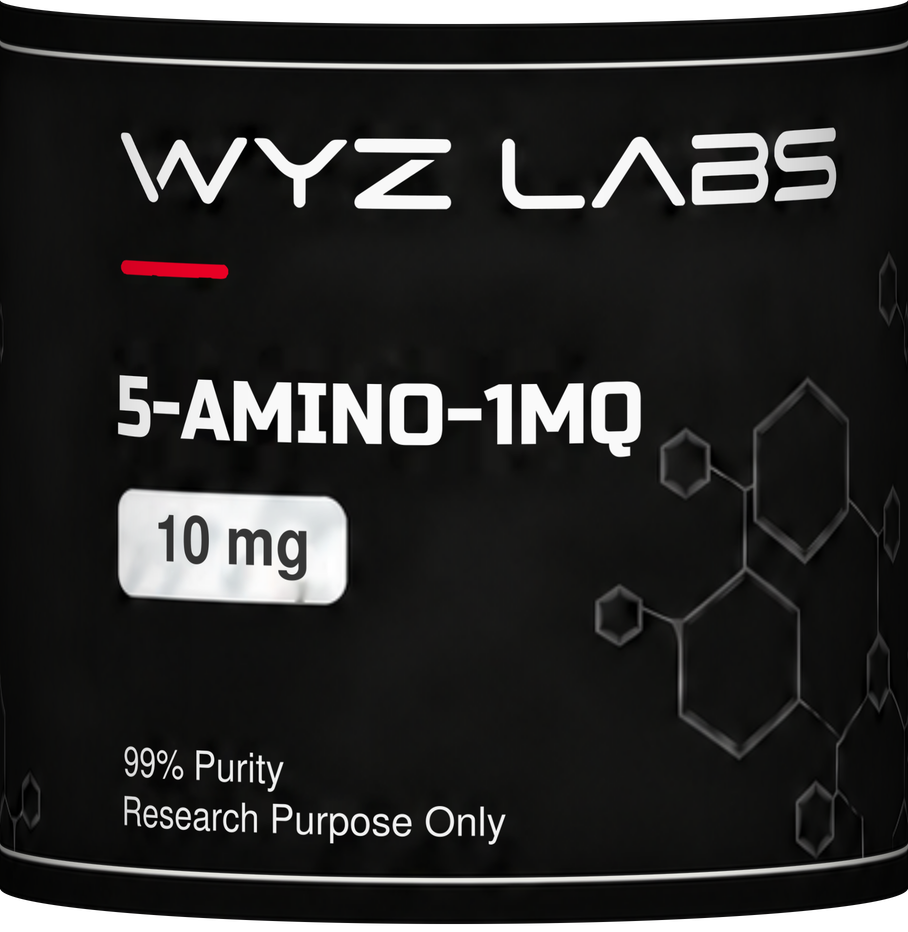
5-amino-1MQ is a small-molecule inhibitor of nicotinamide N-methyltransferase investigated in biochemical assays, adipocyte cultures and mouse models of diet-induced obesity.
5-amino-1MQ abbreviates 5-amino-1-methylquinolinium. It is a synthetic small molecule, not an amino-acid peptide. Research on this particular quinolinium compound should be distinguished from studies of other NNMT inhibitors, which may have different selectivity, exposure and biological effects.
Reference identity
Research class
Small-molecule NNMT inhibitor
Catalog search names
5 Amino 1 MQ · 5-Amino 1-MQ
Expanded name
5-amino-1-methylquinolinium
Chemical class
Synthetic small molecule
This reference describes the published literature. Exact supplied form and chemical specifications require product-specific documentation. The studies are linked in Selected literature.
Mechanisms under investigation
Nicotinamide N-methyltransferase, or NNMT, transfers a methyl group to nicotinamide. Inhibiting the enzyme can change the availability of nicotinamide and methyl-donor metabolites. Structure-activity work examined quinolinium binding at the substrate site, while subsequent cellular studies connected enzyme inhibition with changes in metabolic pools.
Documented lines of inquiry
Research areas
01
Enzyme inhibition and chemical structure
A medicinal-chemistry study compared related molecular scaffolds and substitutions using enzyme assays and computational docking. It established a framework for studying NNMT inhibition, while showing that closely related compounds can differ substantially in activity. [1]
02
Adipocyte metabolism
Cell experiments with 5-amino-1MQ measured lower levels of the NNMT product 1-methylnicotinamide alongside altered NAD+ and methyl-donor availability. These are biochemical observations in cultured fat cells, rather than evidence that all tissues respond identically. [2]
03
Diet-induced obesity models
A short mouse study reported reduced body weight and adipose-tissue measures without a corresponding reduction in food intake. It provided preclinical proof of concept, but its limited duration and animal setting constrain interpretation of efficacy and safety. [2]
Study topics describe the cited models, not established benefits of this catalog material.
Reading the evidence
What the studies can tell us.
Biochemical, cell and animal evidence
The selected publications examine the molecule directly, rather than inferring its activity solely from NNMT genetics or a different inhibitor. They support its use as an experimental probe of metabolic regulation. They do not provide controlled human evidence for weight loss or metabolic treatment.
What remains uncertain
Cell permeability and biochemical selectivity do not establish human absorption or long-term safety. Short animal experiments cannot resolve effects of sustained NNMT inhibition across different organs. Claims about clinical benefit, lifespan or WYZ material quality would require separate evidence beyond these studies.
— Read the source
Selected literature
Primary studies and clearly identified supporting sources. Each link opens the original record.
Literature reviewed October 2026. This is a selected research overview, not an exhaustive systematic review. Published findings do not establish the identity, purity, sterility or suitability of any WYZ batch. For laboratory research only; not for human or veterinary use.
— Before you begin
The details behind the material.
Specifications and storage
Final product specifications and product-specific storage instructions have not been supplied. Review the original documentation and your laboratory’s procedures before obtaining or using the material.
Research use only
For qualified laboratory researchers. Not for human or veterinary use. Product information is not medical advice or a recommendation for personal use.
Retatrutide is a synthetic peptide studied for coordinated activation of three metabolic hormone receptors, with human research examining glucose regulation, appetite, body weight and liver fat.
MOTS-c is a mitochondrial-derived peptide studied in metabolic signaling and skeletal-muscle adaptation, with experimental interventions supported mainly by cell and animal evidence.
GHK-Cu is a copper complex of glycyl-histidyl-lysine studied for its effects on extracellular-matrix production and remodeling in experimental tissue-repair systems.